
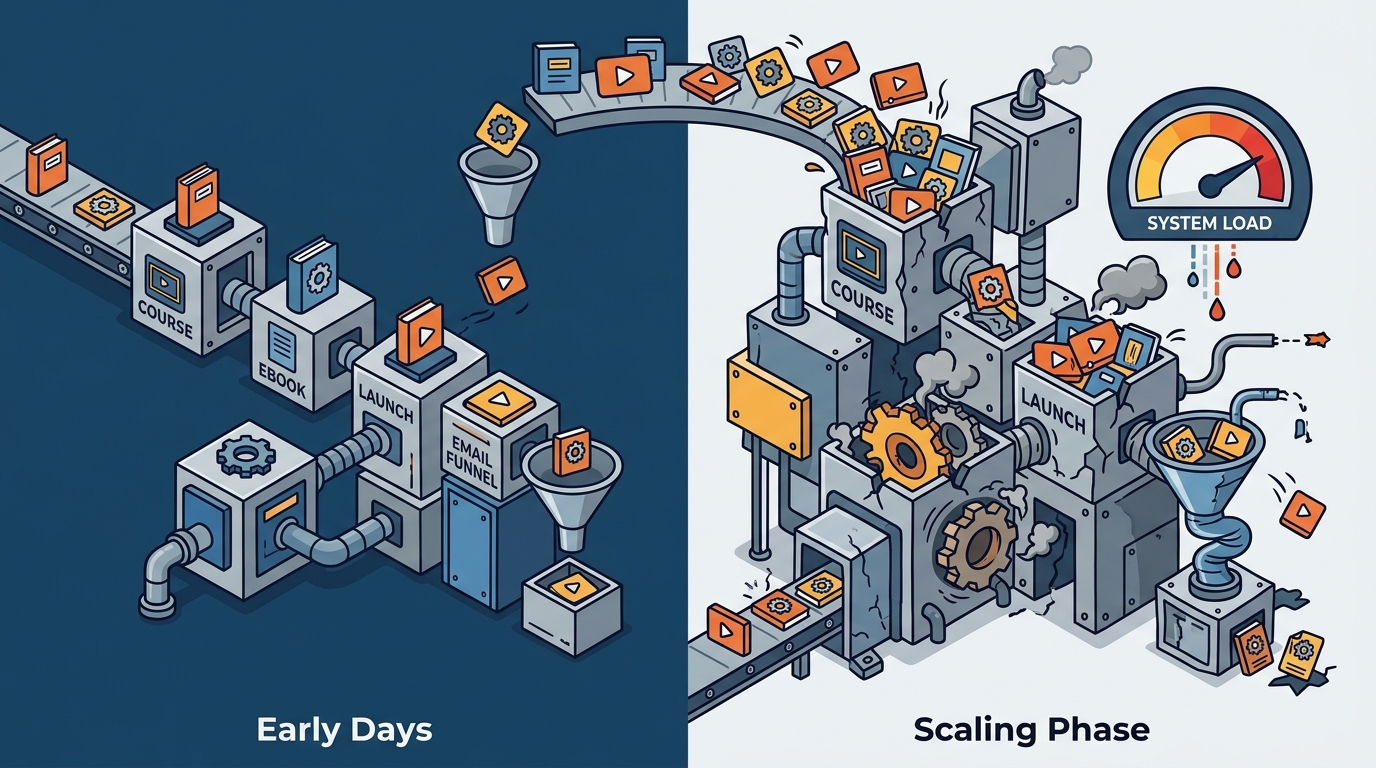
Most creators do not have a content problem. They have a systems problem. As your audience grows, the operational load increases exponentially, often outpacing the infrastructure you built during your early days. According to industry data on digital product growth, creators who fail to upgrade their backend operations see a significant drop in conversion rates during scaling phases. This guide outlines the critical infrastructure hurdles you will face and how to resolve them.
The Trap of Monetization Fragmentation
One of the most immediate challenges in building a scalable backend is the fragmentation of your monetization channels. Early-stage creators often rely on a mix of affiliate links, direct sales pages, and third-party platforms. This scattered approach creates a disjointed customer experience that kills conversion rates.
Monetization fragmentation occurs when revenue streams are not unified under a single operational umbrella. When a customer clicks a link in your bio, they may be taken to a different platform than where they purchased your previous course. This friction causes drop-offs. A unified monetization engine ensures that every touchpoint leads to a clear, structured path to revenue.
To solve this, you must consolidate your offers. This means moving away from disparate tools and toward a cohesive system that handles payments, access, and delivery in one place. According to reports on digital commerce efficiency, unified platforms reduce administrative overhead by up to 40 percent. This allows you to focus on content creation rather than troubleshooting broken links.
Operational Chaos and Workflow Silos
As your brand grows, the volume of tasks multiplies. You are no longer just creating content. You are managing customer support, handling refunds, coordinating with designers, and analyzing analytics. Without a centralized backend, these tasks become siloed, leading to operational chaos.
Operational chaos is defined as the state where business processes are disconnected, leading to inefficiencies, missed deadlines, and customer dissatisfaction. For example, if your email marketing tool does not sync with your payment processor, you risk sending promotional emails to customers who have already churned. This damages brand trust.
Building a scalable backend requires streamlining these workflows. You need automations that trigger actions based on customer behavior. When a user purchases a product, they should automatically receive access credentials, a welcome email, and a survey invitation. This level of automation is impossible to maintain manually at scale.
Investing in backend operations setup is critical here. This involves selecting tools that integrate seamlessly. You must audit your current stack to identify redundancies. If you are paying for three different project management tools, you are wasting resources. Consolidate into a single source of truth for your team.
Digital Product Delivery Infrastructure
For creators selling digital products, the delivery mechanism is as important as the product itself. A common failure point is the lack of a robust digital product infrastructure. This refers to the technical framework that manages asset distribution, user access, and customer experience post-purchase.
When your backend is weak, your delivery suffers. Customers may face login errors, missing files, or inconsistent access levels. This leads to a high volume of support tickets that drain your time. According to data on customer retention in the creator economy, poor onboarding experiences result in a 25 percent higher churn rate within the first month.
To build a scalable delivery system, you must prioritize user experience. This includes mobile-friendly access portals, clear navigation, and instant provisioning of assets. Your backend should handle the heavy lifting of security and access control, ensuring that only paying customers can view your content.
Consider the scalability of your hosting and delivery network. If you are self-hosting large video files, you may face bandwidth issues during a product launch. Using a dedicated digital product infrastructure allows you to offload these technical burdens to specialized providers who can handle traffic spikes without downtime.
Brand Positioning and Messaging Clarity
Technical infrastructure is only half the battle. The other half is brand positioning. A scalable backend must support clear messaging. If your backend systems are messy, your public-facing brand will appear unprofessional. This disconnect erodes trust.
Brand positioning is the strategic process of defining how your brand is perceived relative to competitors in the minds of your target audience. Your backend systems should reflect this positioning. For example, if you position yourself as a premium expert, your checkout flow and customer support must reflect that premium quality.
Clarity in messaging starts with your offer structure. Are you selling a single course, a membership, or a high-ticket coaching program? Your backend must be configured to support this specific model. Trying to force a complex backend to fit a simple offer is inefficient. Conversely, using a simple backend for a complex offer leads to operational collapse.
Regularly audit your brand touchpoints. Does your email signature match your website design? Do your social media links lead to a consistent landing page? These details matter. According to studies on digital trust, consistent branding across all platforms increases perceived credibility by 33 percent. Your backend systems are the foundation of this consistency.
Strategic Scaling and Automation
Scaling is not just about adding more features. It is about adding efficiency. The key challenge in scaling is maintaining quality while increasing volume. This requires a shift from manual processes to automated systems.
Automation is the use of technology to perform tasks with minimal human intervention. In the context of creator brands, automation handles repetitive tasks such as email follow-ups, content scheduling, and customer onboarding. This frees up your time to focus on high-value activities like strategy and content creation.
However, automation must be implemented strategically. Over-automating can make your brand feel impersonal. The goal is to automate the mundane, not the human connection. For example, automate the delivery of a course, but use personal video messages for onboarding.
As you scale, you will need to revisit your tech stack. What worked for 1,000 subscribers may not work for 10,000. You may need to upgrade from a basic email tool to a marketing automation platform. You may need to move from a simple website builder to a custom-coded solution. This evolution is necessary for sustained growth.
According to industry benchmarks, creators who invest in backend optimization see an average revenue growth of 20 percent year-over-year. This is not because they create more content, but because they capture more value from their existing audience through efficient systems.
Key Takeaways
- Monetization Unity: Consolidate all revenue streams into a single, cohesive engine to reduce friction and increase conversions.
- Workflow Integration: Eliminate operational chaos by connecting your tools. Ensure your email, payment, and project management systems communicate.
- Delivery Infrastructure: Invest in a robust digital product infrastructure that handles access and security automatically to reduce support tickets.
- Brand Consistency: Your backend must reflect your brand positioning. A messy backend signals a messy brand to potential customers.
- Strategic Automation: Automate repetitive tasks to free up time for high-value work, but keep the human touch in customer interactions.
- Scalable Tech Stack: Regularly audit your tools. Upgrade your infrastructure as your audience grows to prevent technical bottlenecks.
- Revenue Impact: Efficient backend systems are directly linked to revenue growth. Inefficiency is a hidden cost that drains profitability.
Frequently Asked Questions
What is the first step to building a scalable backend?
The first step is to conduct a comprehensive audit of your current systems. Identify where your monetization, workflows, and delivery channels are fragmented. Once you map the chaos, you can begin to organize and consolidate.
How do I know if my backend is too fragmented?
If you find yourself switching between five or more different tools daily to manage one customer journey, your backend is likely too fragmented. This leads to data silos and operational errors.
Can I automate customer support for a creator brand?
You can automate the initial triage of support tickets using chatbots and FAQ databases. However, complex issues should still be handled by humans to maintain brand trust and personal connection.
What is the difference between a backend system and a website?
A website is the public-facing storefront. A backend system is the engine that powers it, including payment processing, user databases, email automation, and content delivery networks. Both are essential for scaling.
How often should I review my tech stack?
You should review your tech stack quarterly. As your audience grows, your needs change. Tools that worked for 1,000 subscribers may become limiting at 10,000.
Is it expensive to build a scalable backend?
The cost varies, but the return on investment is significant. While there is an initial setup cost, the reduction in manual labor and increase in conversion rates typically pays for the system within months.
What role does data play in backend scalability?
Data is the fuel for decision-making. A scalable backend collects data on customer behavior, allowing you to optimize your offers and marketing strategies based on real evidence rather than guesswork.
Next Steps for Your Brand
Building a scalable backend is not a one-time project. It is an ongoing process of optimization and refinement. If you are struggling with scattered tools, weak product infrastructure, or inconsistent operations, it is time to take action.
BlackTierOps specializes in helping creators build serious brands through clean digital infrastructure. We provide the backend systems, product-ready workflows, and operational clarity you need to scale. Do not let operational chaos hold your brand back.
Request Your Creator Brand Audit today to start your build. Visit our Services page to learn more about how we can help you organize, monetize, and scale your brand.